



Will Kosovo „ignite“ a political clash between Mandić and Đeljošaj?

If anyone thought that Montenegro’s political scene had already seen it all, the initiative to withdraw recognition of Kosovo threatens to shatter even the last illusions of stability. A single move could turn a fragile alliance into a political battlefield, where alliances collapse overnight and partners become opponents with no room for compromise.
The stakes are enormous: the survival of Milojko Spajić’s government, the political fate of the ruling majority, and the country’s strategic direction. If this issue is truly opened, there will be no more room for balancing - someone will have to make a decisive move.
The initiative by the Democratic People's Party leader Milan Knežević for Montenegro to withdraw recognition of Kosovo’s independence raises serious political questions and threatens to shake the ruling majority. In addition to calling into question relations within the Democratic People's Party – New Serbian Democracy alliance, this idea could have far-reaching consequences for the survival of Spajić’s government. If it is launched, and if supported by the current Speaker of Parliament, there is a real possibility of a serious political conflict, particularly between the NSD and the Albanian Forum, i.e. between Andrija Mandić and Nik Đeljošaj.
HOW MANDIĆ WAS ELECTED
To recall, Andrija Mandić was elected Speaker of Parliament on October 30, 2023, with the votes of MPs from the coalition For the Future of Montenegro, the Europe Now Movement, Democratic Montenegro, United Montenegro, the Albanian Forum, and the Socialist People’s Party, with the support of independent MPs Radinka Ćinćur and Jevrosima Pejović.
MPs from the Democratic Party of Socialists, Social Democrats, Bosniak Party, Democratic Union of Albanians, and the Civic Movement URA did not attend the session.
Although the Albanian Forum directly supported Mandić’s election, it is hard to expect that it would look favorably on his potential support for an initiative to withdraw recognition of Kosovo.
A TEST FOR THE ALBANIAN FORUM
A key question arises: how will the Albanian Forum position itself toward Mandić if he supports Knežević’s initiative? Will AF leader, Deputy Prime Minister and Minister of Economic Development Nik Đeljošaj still consider him a partner, or will he repeat the words he addressed to him in 2024?
At that time, Đeljošaj said he hoped Mandić would not again associate Albanians with what he described as a „chauvinistic project“ of dual citizenship, making it clear that he would not participate in creating a „Serbian world“ or any similar national projects.
To recall what Đeljošaj said in 2024:
He stressed that he would not take part in creating a „Serbian world“, nor any other imaginary worlds based on national lines. The leader of the Albanian Forum said it was cynical for Mandić to mention Albanians at all, he wrote on Facebook.
- All the more so since we already know how you „operate“, and we have seen in practice that you respect neither your word nor your signature. Albanians have their own representatives and they will know how to resolve their issues/problems, and you are the last person who can mention them. We made a mistake once by trusting your signature and your word, but not anymore, and we will find mechanisms and wait for the day to erase the vote we gave you, that is, for the Speaker of Parliament - he stated at the time.
FROM CONFLICT TO COOPERATION
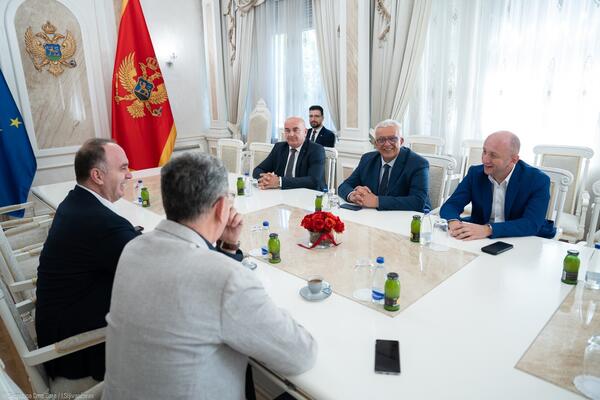
Despite the harsh words, political relations changed the following year. During 2025, a meeting was held, as announced at the time by NSD, between leaders of Serbian parties - Andrija Mandić, Milan Knežević and Vladimir Joković - and representatives of the Albanian Forum, Nik Đeljošaj and Nikola Camaj.
On that occasion, it was emphasized that Serbs and Albanians in Montenegro have a long tradition of coexistence and mutual respect, and that despite differences on regional issues, there remains a shared commitment to European Union membership.
PARTNERSHIP WITHOUT TRUST
The Albanian Forum and NSD are partners in the executive branch, but this has not prevented conflicts between them. The rhetoric has often been sharp: Đeljošaj warned about „chauvinistic projects“, while the coalition For the Future of Montenegro accused him of chauvinism toward Serbs.
The conflict culminated when the Albanian Forum labeled Mandić an „irreparable Albanophobe“, accusing him of inciting hatred and using inflammatory rhetoric.
A POTENTIAL POLITICAL CRISIS
In such an environment, the initiative to withdraw recognition of Kosovo represents a serious test of the government’s stability. Its potential launch could deepen existing divisions and lead to a political outcome in which the Government faces the loss of support from key partners.