



Milović: Montenegro - from investment star to populist downfall

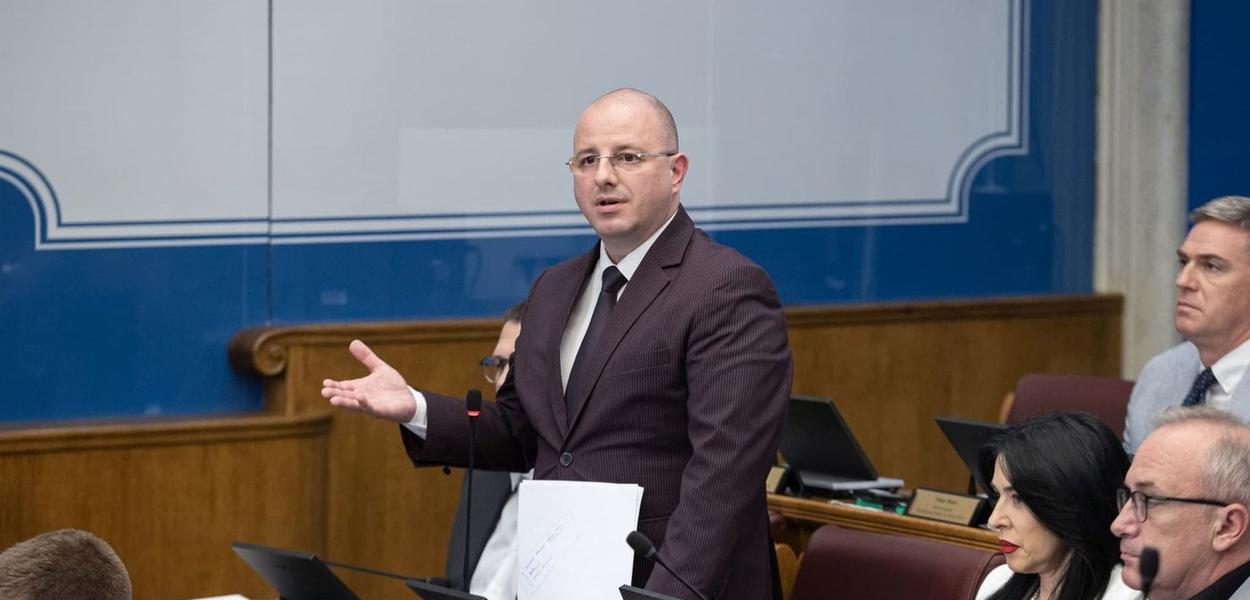
Twenty years after restoring its independence, Montenegro once again finds itself at a political and economic crossroads. How Montenegro transformed from a country attracting billions in investments and building a European image into a country marked by economic stagnation and lost investor confidence, why citizens today have higher salaries but lower purchasing power, and why replacing the current government has become a matter of national interest, professor Nikola Milović, Secretary General of the Democratic Party of Socialists and member of the Parliament of Montenegro, discusses for Portal ETV.
Citizens live harder despite higher salaries
PORTAL ETV: What is your message to citizens who believe they live worse today than they did a few years ago?
Milović: The only party responsible for citizens living worse today is Milojko Spajić’s Government, which is incapable of offering any response to the runaway inflation that is devastating household budgets. Prices in Montenegro are rising uncontrollably, far faster than the real value of citizens’ incomes. Since 2020, salaries have increased only nominally, which means citizens today can buy far less with the same money than before.
For the record, from 2006 to 2020 Montenegro experienced stable growth in living standards. The average salary increased from 345 to 527 euros, while GDP per capita nearly doubled. Inflation was low and controlled, enabling real growth in purchasing power.
Today, citizens do receive nominally higher salaries, but they live worse. Comparing 2019 and 2026, an average family today spends 130 euros more annually on bread, 756 euros more on milk, cheese, and eggs, 204 euros more on meat, 324 euros more on fuel, and as much as 2,400 euros more on rent. Milojko Spajić’s Government is pursuing a wasteful policy and a consumer-populist model that is disastrous for Montenegro’s living standards and economy.
European standards stalled after 2020
PORTAL ETV: Can Montenegro, despite political divisions and economic challenges, reach European Union standards?
Milović: It is worth recalling that from 2006 to 2020, thanks to the economic policy of the Democratic Party of Socialists and its coalition partners, Montenegro moved from 35% of the EU average in purchasing power parity to as much as 50%. That is a clear indicator of the economic progress we achieved. By comparison, from 2020 to 2026 Montenegro only reached 51% of the EU average. In other words, the growth process has almost completely stalled because of the catastrophic economic policies of the post-August governments.
The period after 2020 has been marked by political instability because people hungry for power and privileges came into positions of authority. Such instability destroyed Montenegro’s image as an attractive investment destination. This government drove away many investors who had invested in Montenegro and created new jobs, especially in tourism.
Today, not only are there no new projects, but they are incapable even of completing projects started by the previous government. That is why I stress that, in order to reach European standards, we need political stability and an economy based on investments and the creation of new value. And for that, it is necessary to remove this ignorant, incompetent, and ill-intentioned government in the next elections.
Montenegro has lost investment credibility
PORTAL ETV: Has the state lost credibility among serious investors because of political and institutional instability?
Milović: During the period when the government led by the Democratic Party of Socialists was in power, Montenegro was an exceptionally attractive investment destination. Foreign direct investments amounted to around 20% of GDP, and from 2006 to 2020 more than 11 billion euros were invested in the country. That alone speaks volumes about investor confidence.
There was a clear vision of developing tourism as Montenegro’s key national brand. Montenegro was being built as a year-round tourist destination. The arrival of Aman and the development of Sveti Stefan were part of a strategy aimed at creating the image of a luxury and prestigious destination.
Porto Montenegro, Portonovi, and Luštica Bay emerged from that strategy. This confirms that the policy of the Democratic Party of Socialists was state-responsible and focused on Montenegro’s interests.
Since 2020, foreign investments have fallen to around 7% of GDP. Particularly concerning is the decline in investments in the real sector, while real estate investments dominate. The current government is responsible for this situation because it constantly generates political and institutional instability - and stability and predictability are precisely the key factors for serious investors.
Salary growth without development is unsustainable
PORTAL ETV: How sustainable is a policy of rising salaries and consumption without strengthening production and the economy?
Milović: Until 2020, salary growth was based on economic growth and investments, meaning it was built on a sustainable model grounded in the creation of new value. Today’s salary growth is not the result of economic development, but of administrative decisions. Montenegro today does not produce enough, lacks economic substance, and finances itself through borrowing.
Public debt is constantly rising, as are tax burdens. This situation is not sustainable without growth in productivity and the creation of new economic value. Every responsible head of household knows they cannot spend more than they earn.
Montenegro today is governed by a policy of hyperinflationary populist promises. It is true that they came to power on the basis of populism and „billboard economics“, but that same populism will ultimately remove them from power, because citizens no longer believe the grand lies that they live better than before. When a government has to convince citizens that they enjoy a better standard of living, it means it has lost touch with reality.
Independence brought investments and development
PORTAL ETV: What are the greatest economic benefits that independence brought to Montenegro?
Milović: The greatest benefits were clearly visible in the period from 2006 to 2020. During that time, GDP per capita nearly doubled, salaries and pensions grew on real foundations, and more than 11 billion euros were invested through foreign investments.
Infrastructure developed significantly, and tourism became Montenegro’s key national brand. The world’s most prestigious brands came to Montenegro, helping to build the image of a desirable European tourist destination.
Major investments were also realized in the energy sector. The undersea cable permanently changed Montenegro’s position and turned it into an important energy hub between the Balkans and Italy. Montenegro was then steadily advancing toward the European standard of living.
Relativizing may 21 is a political defeat for opponents of independence
PORTAL ETV: How do you comment on the fact that the significance of restored independence and the values of May 21 are being relativized today?
Milović: The significance of restored independence is being relativized by those who never reconciled themselves with the fact that Montenegro chose in 2006 to become its own free and sovereign state. It is regrettable that today its fate is being decided by people who opposed its independence and European future.
The emancipatory nature of our policy is best demonstrated by research showing that today around 70% of citizens would vote for independence. Even our fiercest political opponents now, for the sake of holding onto office, operate within the framework of an independent, civic, anti-fascist, and European Montenegro.
The importance of May 21 is also confirmed by the economic results achieved after the restoration of independence. From 2006 to 2020, the foundations for development, investments, and European integration were laid.
After 2020, development stopped, investments dried up, and progress toward the EU has become more a result of Brussels’ ambition to keep the enlargement policy alive than of this Government’s work. That is why it is not an exaggeration to say that replacing this government today is a matter of national interest.