



Komar: European integration will not eliminate key social divisions in Montenegro; Backović: It is necessary to ensure balanced and depoliticized education about the country’s history

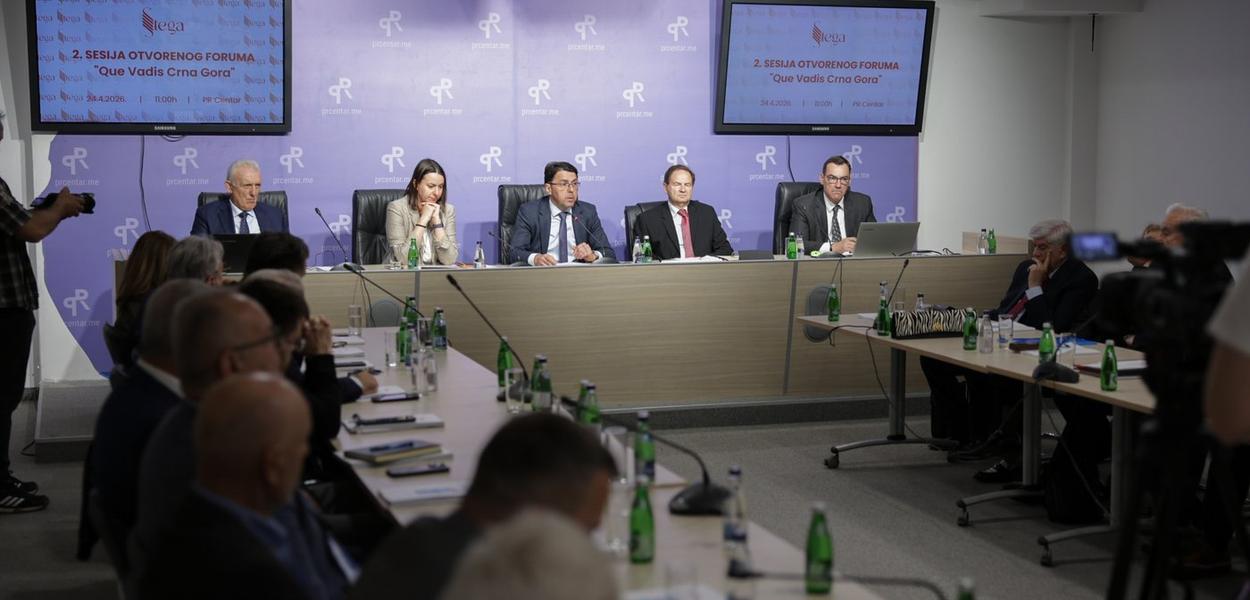
Montenegrin society is deeply divided and institutionally weak, with unresolved identity issues. Although European integration represents a framework for development, internal reforms, strengthening of institutions, and social cohesion are key to the country’s stability and progress.
This was concluded at the Open Forum „Quo vadis, Montenegro – perspectives, expectations, and challenges of Montenegrin society“, viewed through the lens of integration and identity, organized by the Strategy for a European and Civic Montenegro (STEGA).
The moderator of the forum, professor Branislav Radulović, stated that Montenegro today lacks the necessary level of social cohesion on key issues of societal development and its future.
- The state is increasingly becoming a community of party interests, secularism is being replaced by a kind of „show-business religion“ marked by excessive populism and historical revisionism. Instead of the rule of law, we have obtained the right to rule, and susceptibility to foreign influence is undermining the internal security system and the foundations of a defined (pro-Western) foreign policy - Radulović said.
He believes that in such an „anti-system“, the value system is being lost, and instead of debates on substantive issues, outdated identity topics are being offered.
- Thus, instead of unifying society around EU values, we are again getting a „conflict society“ incapable of developing from within, which is precisely the goal of certain clerical-radical right-wing actors both in Montenegro and beyond - Radulović added.
He assessed that in such an environment, the original and authentic pro-European core of society must „awaken“ and become more strongly connected and visible in the public sphere.
Professor at the Faculty of Political Sciences Olivera Komar warned against the mistaken belief that EU membership will resolve identity issues in Montenegro.
- This is a deeply social issue and a key driver of the political system. Such issues exist in all societies, whether related to class divisions, religion, language, or identity. In Montenegro, it is precisely identity - Komar explained.
She pointed out that certain aspects will improve with EU membership, such as the status of the Montenegrin language and the strengthening of institutional mechanisms, but emphasized that core identity issues must be addressed at the national level through educational and cultural institutions.
Komar stressed that European integration will not eliminate key social divisions in Montenegro, but that Montenegrin identity is not in conflict with European values.
She also highlighted that the integration process can contribute to strengthening a sense of solidarity, which is necessary for building a stable civic identity.
- These issues remain ours, and we must address them within our own society - Komar concluded.
Longtime World Bank lead expert and visiting lecturer at Johns Hopkins University in Baltimore, Željko Bogetić, assessed that Montenegro has a strong development foundation, but that a key breakthrough depends on implementing deep economic and institutional reforms.
He stated that Montenegro has reached the highest level of development in the Western Balkans, with GDP per capita of around $12,000, bringing it closer to the threshold of developed countries. According to him, most key economic and social indicators place the country between 60th and 70th in the world, meaning it is „already playing in the Premier League“, albeit in its lower tier.
Bogetić emphasized that European integration is a key driver of development, noting that all new EU member states reached developed-economy status relatively quickly. As he put it, the question is not whether Montenegro will progress, but to what extent it will use that potential.
Speaking about challenges, Bogetić stressed the need to strengthen fiscal stability and reduce public debt, as well as to implement structural reforms, including combating corruption and crime, strengthening the rule of law, and reforming public administration. He also highlighted the green transition and improvements in education, healthcare, and social protection as additional priorities.
Bogetić noted that there are no quick solutions and that progress requires political will and consistent implementation of reforms in the public interest. Even small steps in that direction, he said, could significantly improve citizens’ quality of life in the coming years.
Assistant professor at the University of Donja Gorica, Nikola Šaranović, stated that current disputes over state symbols do not contribute to unity but represent „symptoms of social disintegration“.
He believes that an additional problem is the insistence on discontinuity, particularly through interpretations that Montenegro’s statehood was restored in 2006, which, in his view, neglects historical continuity.
- If identity cannot exist without continuity, answers to today’s divisions should not be sought in points of rupture, but in what has connected us over time - Šaranović said.
He assessed that a shared past, although often a source of division, can be a basis for overcoming differences „but only if society is ready to confront its own legacy“.
- The answer to the question „Quo vadis, Montenegro?“ lies in a paradigm shift, from „either-or“ to „both-and“, that is, in a new internal synthesis that will ensure stability without the need for external guarantees - he concluded.
Academician Slobodan Backović assessed that meeting legal and economic standards is not sufficient for successful European integration, and that it is necessary to build a clearly defined and stable state identity.
Discussing challenges, Backović emphasized that identity is both a key issue and a development potential. He highlighted several areas as priorities in strengthening the state identity. First and foremost, he emphasized the need to strengthen institutions, not by increasing the number of employees, but by improving their knowledge and efficiency. According to him, citizens’ trust in the state directly depends on the strength and functionality of its institutions.
- Citizens will not trust the state as long as institutions do not function properly - Backović said.
He stressed the need to ensure balanced and depoliticized education about Montenegro’s history, with an emphasis on statehood, anti-fascism, and the multiethnic character of society. He also warned against the dangers of revisionist interpretations of history.
Backović believes Montenegro must further develop a civic identity in line with the European model of the state, in which identity is not tied exclusively to nation or religion. He pointed to the problem of national political parties, which, in his view, often act contrary to the concept of a civic state.
Vice President of the Montenegrin Lawyers’ Association, professor Maja Kostić Mandić, assessed that functionally underprepared and poorly educated lawyers, who are not accustomed to demanding and thorough work on legal issues, are „coming back to haunt us“.
- To change this over time and to build and strengthen the integrity of legal professionals within EU integration, quality education is essential. Knowledge and integrity are something no one can take from you, and they give you the freedom to choose your profession and workplace within a market of over 450 million people - she said.
Representative of Matica crnogorska, Ivan Ivanović, assessed that part of the political elite assumes that identity issues will resolve themselves spontaneously or through EU accession, which he considers wrong.
- No supranational integration will solve what is our domestic task - Ivanović said, adding that society must fight for the Montenegrin national identity and the character of the state.
He warned that Montenegro still lacks clearly defined national and state goals and interests, which prevents the creation of a long-term development strategy.
Speaking about EU integration, Ivanović pointed out that the European Union is developing a shared identity, which may pose a challenge for countries that have not fully consolidated their own identity. Cosmopolitanism, he noted, is easier to accept in countries with a stable and secure identity.
In that context, he assessed that Montenegro is entering the EU integration process as an identity-incomplete, institutionally weakened, and socially divided community.
Ivanović stressed that the struggle to preserve sovereignty and identity will not end with EU accession but will require continuous engagement.
Professor Boro Vučinić from the editorial board for International Relations and Security assessed that Montenegro’s European path is a realistic goal, but that global circumstances require serious reconsideration of the direction the country is taking.
Speaking about the contemporary geopolitical context, Vučinić noted that Montenegro’s NATO membership is its most important achievement since regaining independence, but warned that the Alliance is currently facing serious challenges.
According to him, NATO is in a kind of paralysis and is functioning with difficulty, which is unfavorable for small states like Montenegro that see it as a key guarantee of security and sovereignty.
Speaking about the European Union, he noted that it is also facing significant challenges. Europe, he said, can no longer rely on free American security protection, cheap energy from Russia, or favorable global economic conditions as it once did.
According to him, the EU faces a choice between two development models: reforming NATO with greater European contribution or strengthening its own strategic autonomy. Both models, he emphasized, imply significantly increased defense spending and stronger political cohesion.
Vučinić warned that such global changes may pose serious challenges for small states, stressing that they must pay additional attention to their own stability.
He concluded that, alongside EU integration, achieving internal democratic and political stability is crucial for Montenegro.
Director of Radio-Television Nikšić, Nikola Marković, assessed that the identity of modern societies largely depends on media integrity, noting that Montenegro has not adequately regulated its media landscape since regaining independence.
According to him, the media scene in Montenegro is fragmented and often misused, contributing to societal degradation and weakening of the state.
Marković believes that political elites, from the referendum to the present day, have not understood, or have not wanted to understand, the role of professional media.
- Critical media are not enemies of the government, but its corrective - Marković said.
He assessed that social cohesion can only be built through professional and responsible media, emphasizing that such media are essential for the stability and identity of the state.
Editor-in-chief of Antena M, Darko Šuković, assessed that Montenegro’s media space is „occupied“, noting that this process did not begin with the political changes of 2020, but has much deeper roots.
According to him, the key problem arose two decades ago, when broadcasting frequencies, as a national resource, were allocated without a clear strategy.
- Frequencies are a resource like bauxite or the coastline, and we have been giving them away without a long-term plan - Šuković said.
He also warned about the collapse of the value system, noting that standards of public communication have significantly deteriorated, with insults and reputational harm becoming insufficiently sanctioned.
Speaking about the structure of the media scene, he assessed that the number of media outlets and journalists acting in the interest of what he called „a different Montenegro“ is very small, and has further declined in recent years.
Šuković warned of pressures faced by independent and critical media, including campaigns aimed at undermining their credibility and financial stability.
- Those who are the target of criticism often understand the importance of free media better than those who should support them - he concluded.
Esko Muratović stated that he advocates for an „ethics of togetherness“ and interculturalism as an approach that could contribute to a better understanding and definition of integration in Montenegrin society.
He pointed to the existence of ethnic and other divisions and distances in Montenegro, noting that they remain present in social life.
Speaking about the importance of education, Muratović said that identity and societal development are largely based on the education system. He emphasized the need to reassess how academic ethics, fairness, and responsibility are treated in education.
- Europe and the world are watching us closely - he said, adding that it is necessary to clearly define what identity is and how it is understood in Montenegrin society - whether in national, linguistic, religious, or civic terms.