



The ghost of revisionism haunts Montenegro

Instead of the customary Statehood Day greetings and tributes to the defining moments of Montenegrin history, something that would be almost ceremonial in any normal state, Montenegro has once again been presented with attempts to rewrite history, this time woven into supposedly „friendly“ holiday messages.
For years, those who deny Montenegro's statehood, independence, national identity, and anti-fascist heritage have sought to portray the July 13 Uprising as a spontaneous nationwide revolt, while downplaying and erasing the role of the Communist Party of Yugoslavia in organizing it. The uprising was indeed a popular, nationwide movement, as peasants, workers, students, communists, and officers of the Royal Yugoslav Army all took up arms against the Fascist occupation. However, there is a clear distinction between those who organized the uprising and those who joined it. The uprising was organized exclusively by the Communist Party of Yugoslavia, which began preparing for armed resistance immediately after the April War and formally decided to launch the uprising at Ravni Laz in Piperi.
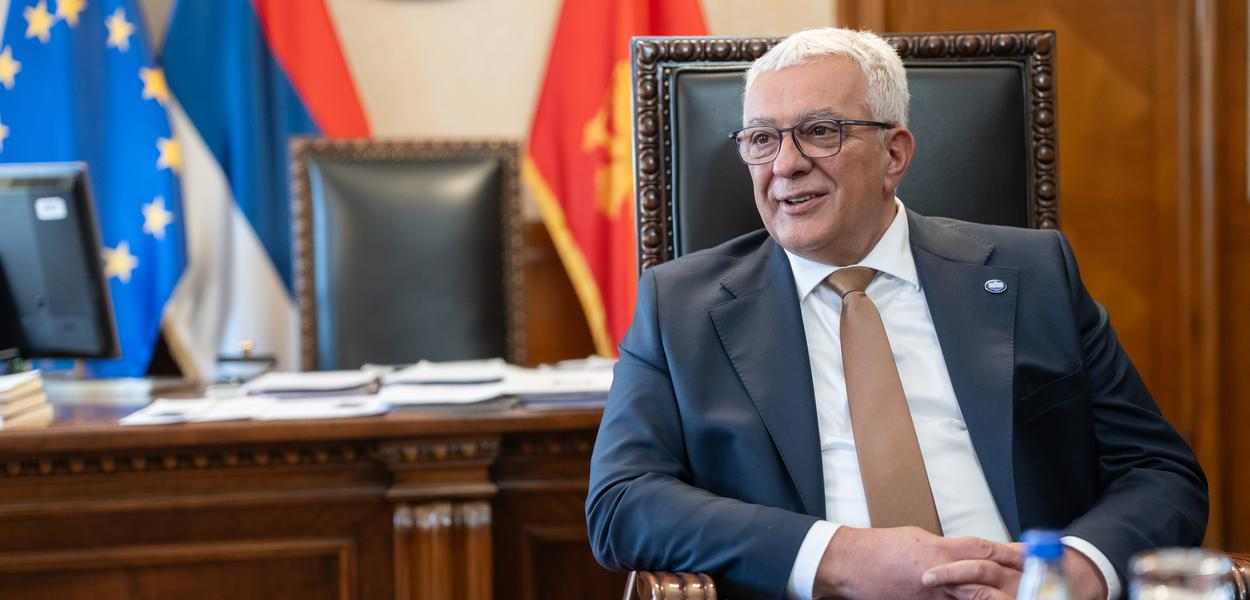
The latest wave of historical revisionism was officially endorsed yesterday by Speaker of Parliament Andrija Mandić in his Statehood Day message. In his version of history, the officers of the Royal Yugoslav Army, to whom he paid special tribute, were the true leaders of the uprising's greatest battles, only to be erased from history by what he described as „the totalitarian communist regime and compliant, false historians“.
Having first legitimized the narrative that the National Liberation Struggle, the Communists, and the Partisans were merely instruments of a totalitarian regime, it may not be long before the Parliament of Montenegro, after adopting the resolution on the genocide committed in Jasenovac, Dachau, and Mauthausen, proceeds to adopt a resolution similar to that passed by the European Parliament condemning the crimes of totalitarian regimes. Curiously enough, such resolutions have been enthusiastically welcomed by right-wing political parties, including Croatian war veterans (admirers of those who once fled together with Montenegro's self-proclaimed „new anti-fascists“).
In his congratulatory message, Mandić also presented what until now has been an unknown historical „fact“, previously promoted only by media outlets close to him. He claimed that the uprising „was jointly launched by people for whom, in the Kingdom of Yugoslavia, it had previously been unimaginable to sit at the same table“, concluding that „our grandfathers and grandmothers were not primarily inspired to rise up by reading Karl Marx and Friedrich Engels, but by the writings and covenant of Petar II Petrović Njegoš and Saint Peter of Cetinje“.
Since Mandić argued in his address that „historians should be left to deal with the wrong paths we followed for so long“, I feel both free - and obliged - as a historian to do precisely that, and to point out the obvious and dangerous examples of historical revisionism now being promoted from the highest levels of the state.
By deliberately ignoring the actual organizers of the July 13 Uprising and those who alone persevered throughout the four-year struggle for liberation against the occupying forces, Mandić instead chose to present a new hero. He paid special tribute to „one of the key leaders of the uprising, Jakov Kusovac, a major in the Royal Yugoslav Army“.
For some time now, the pro-government outlets Borba and IN4S have been filling the gaps in Jakov Kusovac's biography by creating new „historical facts“ designed to manufacture new heroes, because the existing ones do not fit their ideological framework. Those newly invented narratives are then legitimized by the Speaker of Parliament through official state holiday messages.
Jakov Kusovac did take part in the July 13 Uprising. He was one of many Royal Yugoslav Army officers who rejected the Fascist occupation in 1941. However, he was neither a major nor the commander of the entire operation at Košćele.
Kusovac was not a senior-ranking officer but a pre-war transport officer in the Royal Yugoslav Army, and in 1941 he held the rank of captain. The fact that he did not hold a higher rank in no way diminishes the significance of his participation in the Battle of Košćele (a role that post-war historiography arguably neglected), but it does dismantle the revisionist narrative promoted by the Speaker of Parliament, portraying him as a major and „one of the key leaders of the uprising“.
Kusovac ended up in a prisoner-of-war camp in 1943. After his release, he chose not to return to Montenegro for political reasons and instead spent the remainder of his life in Johannesburg, South Africa, where he died in 1958.
There is no evidence that he was active in the Chetnik movement. Little is known about his activities before 1943, but his name does not appear among Chetnik formations. Nor does it appear among the Partisans. Kusovac was not a controversial figure, nor is he associated with any atrocities. At the same time, however, he was neither among the organizers of the uprising nor one of its principal military leaders. Yet the simple fact that he did not join the Communists, combined with the limited historical record about his life, has made him a useful instrument in the latest attempt to rewrite Montenegro's history.
The absence of precise historical information is apparently sufficient for the architects of this new history, set in what the Speaker of Parliament describes as „a Montenegro of free, happy, and prosperous people“, to assign Kusovac new titles, attributes, and a carefully crafted myth that conveniently serves today's political leadership.
They have already realized that Pavle Đurišić, Jakov Jovović, and Bajo Stanišić are not heroes acceptable to the majority of Montenegrin society, and that an openly Chetnik ideology, despite extensive propaganda support from the Serbian Orthodox Church and sympathetic figures across the region, still fails to gain broad public acceptance.
Instead, they are creating new heroes - individuals who are neither controversial nor widely known - precisely because they can be reshaped to fit a desired historical narrative while remaining acceptable to the broader public.
Thus, Jakov Kusovac has become the protagonist of a new historical fairy tale, one that has been written for some time by Borba and IN4S, and is now being institutionalized by Andrija Mandić.
It is often said that a lie repeated a thousand times becomes the truth. Yet a truth established through historical evidence remains the truth forever. History settled these questions long ago. So did archival documents (such as the decision to launch the uprising), photographs (for example, those showing Pavle Đurišić standing shoulder to shoulder with Alessandro Pirzio Biroli), video footage (for example, Metropolitan Joanikije Lipovac walking through Cetinje accompanied by Italian soldiers), and countless other historical sources.
Historical revisionism is being carried out exactly as the leading proponents of nationalist, reactionary, and Chetnik ideology in Montenegro have practiced it for decades. The only difference now is that it bears the signature and official seal of the country's highest state institutions.
And how does revisionism work? You choose a historical event or a historical figure. Someone recognizable, but not too well known. Familiar enough to sound credible, yet obscure enough that most people are unaware of the details. Then you begin to alter those details: invent some, omit others, add new ones, carefully balancing them until the story sounds entirely plausible.
Or, if the subject is a truly iconic historical moment (such as the restoration of Montenegro's independence), you find a way to attach it to a completely different narrative, thereby assigning it a new purpose, meaning, and symbolism. This is precisely what Andrija Mandić attempted when he linked Montenegro's restored independence and its admission to the United Nations to the fulfillment of the so-called Kosovo Covenant.
What is truly remarkable is the speed with which Andrija Mandić, the official face of this revisionist campaign, uses the considerable power at his disposal to produce one revisionist tale after another, narratives conceived in church crypts and university offices alike. He always seems to have at least one ready for every Montenegrin state holiday he wishes to diminish and degrade. As, ultimately, he seeks to diminish and degrade the state itself.
Happy Statehood Day!
Death to fascism, freedom to the People!
Written by Božena Miljić, MA, Historian
(„Smrt fašizmu, sloboda narodu!“ or „Death to fascism, freedom to the people“ is the official slogan of the Yugoslav anti-fascist Partisan resistance during World War II)