



Labeling Mrvaljević an extremist, according to Judge Jokanović, is freedom of expression
Had Mrvaljević’s lawsuit been upheld, as stated in the reasoning of the judgment, it would have constituted interference with the defendants’ right to freedom of expression. The first-instance decision also states that Jovanović and Tomović „opened a discussion on topics of interest to the wider public by expressing value judgments about Mrvaljević which are not subject to proof, and by which freedom of expression was not exceeded to a degree that would require court intervention“

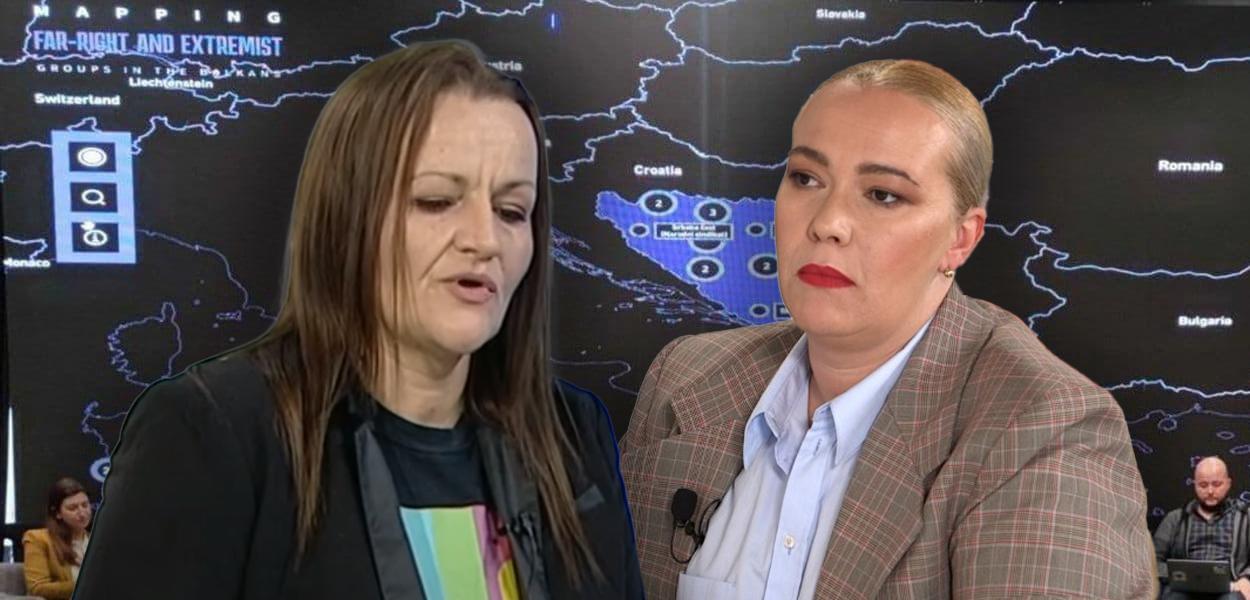
Judge Miloš Jokanović of the Basic Court in Podgorica rejected as unfounded the lawsuit filed by civil activist and executive director of the NGO „Forum Luča“ Nebojša Mrvaljević. The lawsuit was submitted for violation of personal rights of honor, reputation, psychological integrity, and dignity against the author of the propaganda piece „Mapping Far-Right and Extremist Groups in the Balkans“ Jelena Jovanović, who is also a journalist for the daily newspaper „Vijesti“, and against the former editor of BIRN’s Balkan Insight platform Dušica Tomović. This work was presented and published in November 2022, and after strong reactions from the professional public and intellectuals from the region and Montenegro, the map was withdrawn in December of the same year.
After several expert reviews, the map was republished the following year, but the section for Montenegro remained empty.
Judge Jokanović, however, did not find that Mrvaljević’s reputation, honor, or dignity had been damaged by this controversial piece. Instead, in the judgment he also ordered Mrvaljević to reimburse Jovanović and Tomović for legal costs in the amount of 2,382 euros.
JUDGE’S REASONING
In the report prepared for BIRN, Jovanović and Tomović labeled Mrvaljević, along with eight other civil activists, including two journalists, as far-right and religious extremists.
The judge’s position is that Jovanović and Tomović did not „exceed the limits of permissible criticism in those reports, which are considerably broader when it comes to debates on topics that intrigue the public, that is, matters of public interest, in which one of the participants is a public figure“.
Had Mrvaljević’s claim been upheld, as stated in the explanation of the judgment, it would have constituted interference with the defendants’ right to freedom of expression.
The first-instance decision also states that Jovanović and Tomović „opened a discussion on topics of interest to the wider public by expressing value judgments about Mrvaljević that are not subject to proof, and by which freedom of expression was not exceeded to the extent that would require court intervention“.
- This court considers that the title of the project within which the disputed reports were published is harsh, but that alone does not justify awarding the requested non-material damages - the judgment states.
VALUE JUDGMENT AND CRITICAL OPINION?
According to Judge Jokanović’s assessment, Mrvaljević, as a „public figure, must possess a significantly higher threshold of tolerance than persons who have no connection with public appearances“.
He also referred to the practice and examples of the European Court of Human Rights.
- Assessing the content of the reports in question, the court finds that the defendants spoke about topics that can indisputably be characterized as matters of public interest, and that they represent value judgments, that is, critical opinions of the defendants as individuals regarding the plaintiff as a public figure. The court takes the position that Jovanović and Tomović did not intend to harm the psychological integrity, reputation, or dignity of the plaintiff as an individual and citizen. The court concludes that the aim was to point to the plaintiff’s work and activities, that is, his conduct in a public capacity. The court considers that the publication of the disputed reports does not represent pointing to a negative aspect of the plaintiff’s personality, and that the purpose was to inform the public about the manner of the plaintiff’s actions, not to insult, humiliate, or demean him - the explanation of the judgment states.
However, the judge notes that Jovanović and Tomović undoubtedly intended to portray Mrvaljević in a negative context through the prism of his actions as a public figure, which attracted the attention of the wider public.
According to the judge, „without the freedom to receive and exchange opinions, the public cannot participate in social processes, which is precisely why the right to freedom of expression lies at the foundation of every democratic society“.
According to Judge Jokanović, referring to the case law of the European Court of Human Rights, Jovanović and Tomović did not violate Mrvaljević’s personal rights with the disputed reports, nor did they cross the boundaries of guaranteed freedom of expression – „they did not disturb the balance that must exist between that freedom and every individual’s right to the protection of their honor and reputation“.
- It is undisputed that the plaintiff has the right to protection of his personality, primarily through the protection of honor, reputation, and dignity, and that another person’s freedom of expression cannot take precedence over the protection of those rights. However, the court’s opinion is that the thin line that constitutes the balance between the rights of the plaintiff and the rights of the defendants was not crossed, and that the defendants thereby carried out criticism of the plaintiff’s work as a public figure without entering the sphere of the plaintiff’s personal rights or causing a violation of those rights - the judge states in the explanation of the judgment.
He also believes that the BIRN reports do not represent an expression of the defendants’ personal animosity but are directed at Mrvaljević’s professional engagement.
Jokanović also pointed out that Mrvaljević, as a public figure, could have found a way to obtain media space in which to protect himself appropriately - by denying the allegations made in the disputed reports.
In Podgorica, this is the second first-instance judgment. Unlike Mrvaljević, journalist and activist Tanja Pavićević had her lawsuit against Jovanović and Tomović upheld.
The activists and journalists who were harshly targeted also filed lawsuits against BIRN before a court in Sarajevo, and all cases decided so far at the first-instance level have been in their favor, while one proceeding is still ongoing.
In addition to Mrvaljević and Pavićević, Jovanović and Tomović also labeled the following as extremists: civil activists Tatjana Knežević Perišić, Tijana Lopičić, Maja Miličković, Aleksandar Saša Zeković, Predrag Peđa Vušurović, Draško Didije Martinović, and journalist Kaćuša Krsmanović.
The disgraceful map was withdrawn long ago, but an apology from BIRN, Jovanović, and former editor Tomović has never followed. On the contrary, the two persist in claiming that the individuals they dangerously targeted are extremists, and they had previously threatened that the list would be expanded.