



CCE: Remembrance of operation „Storm“ must be based on facts, justice and respect for victims

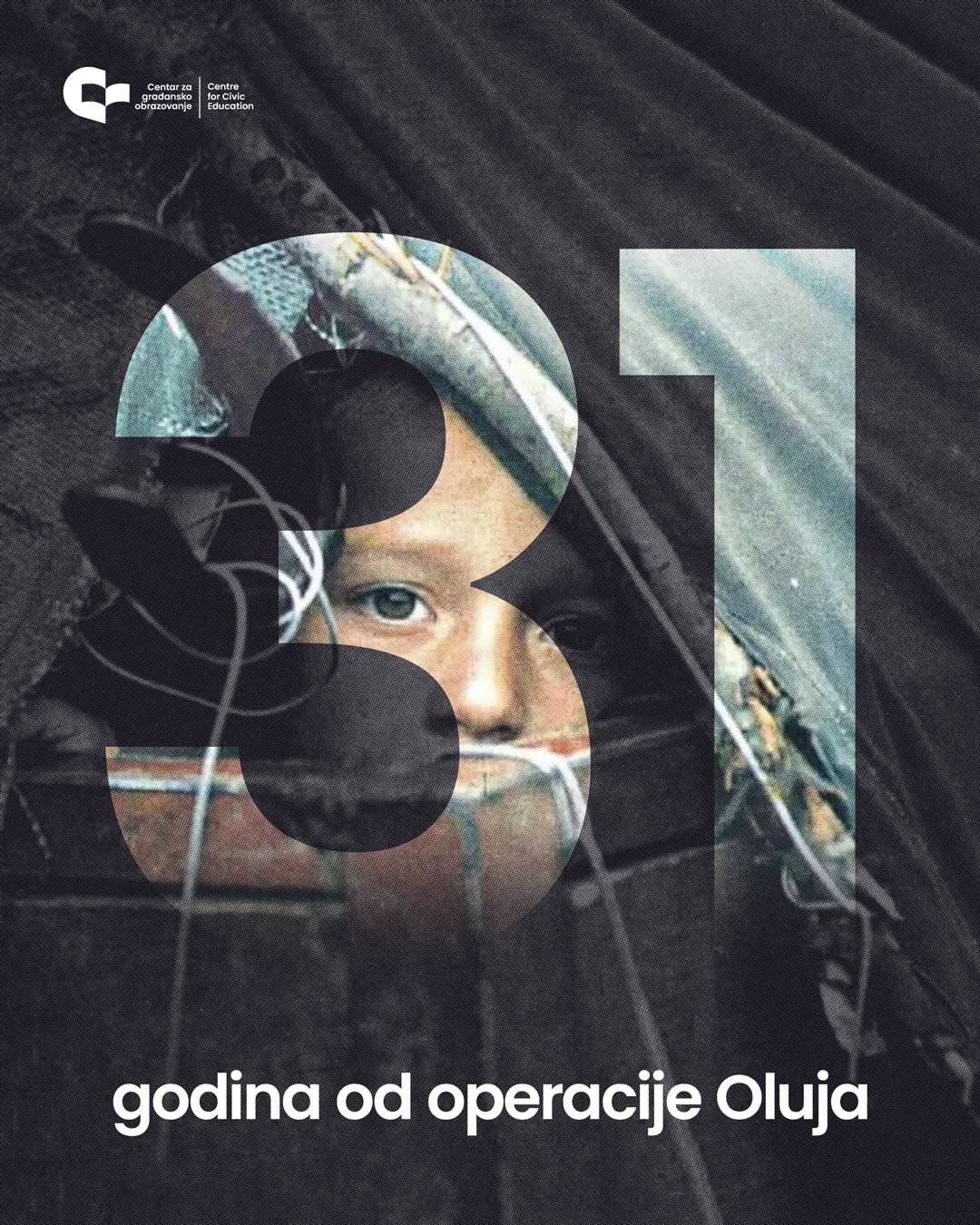
Commemorating victims with dignity requires rejecting their political exploitation and building a culture of remembrance grounded in facts, respect for human rights, and accountability for crimes committed, the Centre for Civic Education (CCE) stated on the occasion of the 31st anniversary of the military-police operation „Storm“ (Original: „Oluja“).
The NGO called on institutions and political actors across the region to contribute to clarifying the fate of missing persons, prosecuting those responsible, and improving education about the wars of the 1990s.
- Only confronting the past based on truth, justice, and empathy can serve as the foundation for lasting reconciliation and trust among societies in the region - CCE said, referring to the operation carried out from 4 to 7 August 1995.
The organisation recalled the suffering of civilians, the mass displacement, and the loss of homes experienced by tens of thousands of people, while also emphasizing the enduring obligation to prosecute war crimes and ensure justice for all victims.
- Following the breakup of Yugoslavia and Croatia's declaration of independence in 1991, the self-proclaimed Republic of Serbian Krajina was established in parts of Croatian territory inhabited by a large Serbian population. Operation Storm, launched with the attack on Knin on 4 August 1995, marked its end but also the beginning of the mass exodus of the Serbian population from Krajina. During the operation and in the period that followed, numerous crimes were committed against Serbian civilians and their property - the statement said.
It is estimated that around 200,000 people were expelled, primarily to Bosnia and Herzegovina, Serbia, and other successor states of the former Yugoslavia.
- According to a report by the Croatian Helsinki Committee (HHO), at least 22,000 houses were burned, while many others were looted or destroyed. According to data from the Centre for Dealing With the Past in Zagreb, which has also published a nominal list of human losses, 1,747 Serbian victims and 466 Croatian victims were recorded during operation „Storm“ and in the period that followed. Among the Serbian victims, civilians make up the majority, while among the Croatian victims, members of the armed forces predominate - CCE stated.
Before the International Criminal Tribunal for the former Yugoslavia (ICTY), Ante Gotovina, Ivan Čermak, and Mladen Markač were indicted for crimes committed during and after operation „Storm“.
- In its 2011 trial judgment, the ICTY sentenced Gotovina and Markač to prison terms of 24 and 18 years, respectively, while Čermak was acquitted. In 2012, the ICTY Appeals Chamber acquitted both Gotovina and Markač. The judgment sparked considerable controversy because the Trial Chamber and the Appeals Chamber reached diametrically opposed conclusions on key issues despite relying on the same facts and the same law. However, the acquittals did not alter the facts regarding human suffering, nor did they diminish the need for accountability for crimes through judicial institutions. Croatian prosecutors have registered 6,390 criminal complaints related to crimes committed during and after Operation Storm, while, according to available data, 2,380 individuals have been convicted. However, no publicly available information exists regarding the identities of those convicted or the specific criminal offences for which they were held responsible - CCE said.
August brings two different commemorations and two different perspectives on the same military operation.
- Croatia marks 5 August as Victory and Homeland Thanksgiving Day and Croatian Veterans' Day, while Serbia observes 4 August as the Day of Remembrance for the Killed and Expelled Serbs. These differing perspectives reflect opposing collective memories and political interpretations, with the experiences of victims, the need for reconciliation, and the rebuilding of trust often pushed into the background. What remains undisputed are the human losses, destroyed homes, and widespread devastation, making a comprehensive examination of all the facts the only responsible approach to the past - CCE stressed.
Issues concerning missing persons, displaced people, the prosecution of war crimes, reparations, and dignified memorialisation remain unresolved even after three decades.
- Victims and their families are still waiting for full justice, while the political instrumentalisation of wartime suffering further hinders coming to terms with the past and reconciliation in the region. Judicial outcomes and differing political interpretations cannot change the fact that grave crimes were committed against civilians during and after the operation, nor can they diminish the suffering of those who lost family members and their homes. It is therefore the responsibility of states, regardless of the victims' nationality, to ensure truth, justice, and dignified remembrance - the statement said.
CCE's research shows that nearly 70% of adult citizens in Montenegro are familiar with Operation Storm, while significant knowledge gaps exist among young people. Fewer than half (46.7%) say they learned about operation „Storm“ during their education, while 44% report that they are unfamiliar with the event.
- These findings confirm the need for the education system to provide young people with knowledge based on verified facts and a critical understanding of the wars of the 1990s, rather than allowing political interpretations and selective narratives to become their primary source of information - CCE concluded.