



Armenko: Without a fully composed Constitutional Court, there is a risk that election results may not be declared

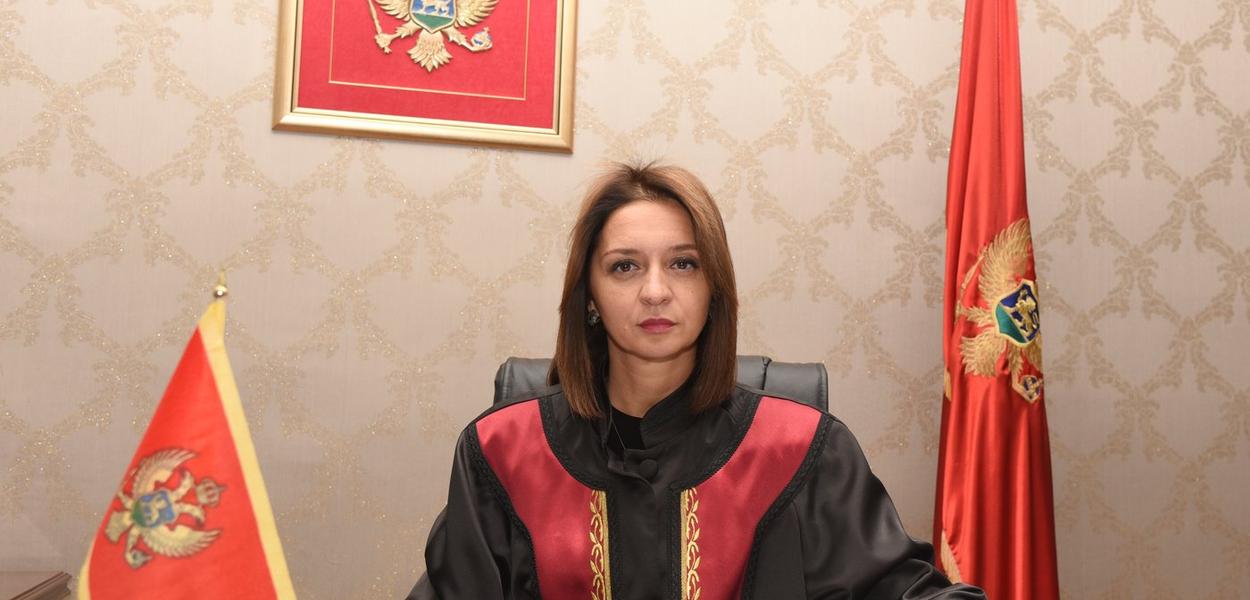
Montenegro should not enter an election year without a fully composed Constitutional Court, said the President of the highest judicial instance, Snežana Armenko, noting that the court cannot be fully functional without all seven judges.
Commenting on the fact that Parliament has not yet decided on two candidates for Constitutional Court judges proposed by the President of the state, Armenko told the MINA agency that it must not be socially or politically acceptable for a composition smaller than seven judges to be considered a functional court.
- Just as Parliament was concerned when it operated for a period with one fewer member than the number prescribed by the Constitution, it must likewise not be socially or politically acceptable for any composition of fewer than seven judges, as stipulated by the Constitution, to represent a fully functional Constitutional Court - Armenko said.
She noted that otherwise, an incomplete panel of judges, when deciding cases, may result in the failure to adopt decisions in situations of divided opinion, which, she added, is ultimately attributed to the Constitutional Court and labeled as political.
Asked whether the court is prepared for a potentially higher number of constitutional appeals, given that parliamentary elections will be held next year, Armenko emphasized the necessity of a complete Constitutional Court.
- Montenegro should not enter an election year without a full composition of the Constitutional Court. In this way, there is a risk of reaching a situation where election results cannot be declared due to the absence of a final decision by the Constitutional Court - Armenko stated.
According to her, only a fully composed Constitutional Court guarantees that decisions will certainly be made.
- The Montenegrin political scene is becoming increasingly complex and demanding, and the fact that, under the new legal framework, local and parliamentary elections are held on the same day leads me to expect that the electoral process will be very challenging for the Constitutional Court - Armenko said.
She added that if, in even a single case, the Constitutional Court is divided in votes on an electoral issue and is therefore unable to reach a final decision, this will lead to a blockage of the electoral process for reasons that cannot be attributed to the Court itself.
Armenko recalled that such a situation occurred in 2022 during the local elections in Podgorica, where the government remained in a technical mandate for six months until new judges were elected.
- That is not a good message for Montenegro to send in the year of accession to the European Union (EU), when we should demonstrate commitment to establishing fundamental democratic principles and the rule of law through a fully functional Constitutional Court in the electoral process - Armenko believes.
She also pointed out that without the appointment of the President and members of the Central Election Commission, the Constitutional Court cannot establish jurisdiction in cases of electoral appeals.
- Because it is necessary for there to first be a decision by this body rejecting or dismissing an objection - Armenko explained.
Speaking about the pace of work of the Constitutional Court and the Case Resolution Program for this year, Armenko said that in the field of normative review, cases from 2018 have already been resolved, except for one that requires comprehensive analysis.
She stated that work is currently ongoing on cases from 2019.
- In the field of constitutional complaints, the oldest cases currently date from 2024 and will be resolved in accordance with the Program by July 1. Therefore, in the second half of the year, the oldest cases the Constitutional Court will be handling in this area will be those from last year, which is a result unmatched by any court in the region - Armenko said.
Speaking about cases that the public is awaiting decisions on, Armenko noted that the Court is aware that current cases occupy public attention.
According to her, the Constitutional Court will, to the extent possible given its composition and staffing capacities, handle those cases in parallel.
She said that in certain cases, the Court has demonstrated that it is capable of recognizing matters of social and public interest and addressing them comprehensively, analytically, and in a timely manner.
In this regard, Armenko highlighted cases concerning the constitutionality review of the Decision on determining tariffs for services performed by the Central Bank, the Branch Collective Agreement in the field of education, and the Agreement in the field of tourism and real estate development concluded between Montenegro and the United Arab Emirates (UAE).
Commenting on claims by part of the public that the Constitutional Court is under political influence from the parliamentary majority, Armenko said that each judge should, through their integrity, dispel such perceptions.
- Convincing the public that the Constitutional Court is not a political court is a process in which each judge must participate individually, through their integrity and clearly expressed positions that they firmly stand behind - Armenko emphasized.
She added that it is a significant intellectual and professional satisfaction that the Constitutional Court has the institution of dissenting opinions, allowing each judge’s voice to be heard, not only when they disagree with a decision, but also when they wish to further explain the reasons for their vote.
- The integrity reflected in dissenting opinions, as well as enabling public hearings on issues of public interest, are precisely the ways for the public to assess whether there is political influence on individual judges - Armenko said.
Asked whether she had noticed disappointment among citizens after the Constitutional Court failed to decide on the constitutionality of the agreement between Montenegro and the UAE, Armenko said that citizens have the right to be disappointed.
- But I am as well, not because of the views of my colleagues, which I respect, but because of the inability for a case of such importance to reach a final outcome and to have its compliance with the Constitution examined at the only relevant instance for this type of constitutional review in Montenegro - Armenko added.
She noted that citizens should know that a 3:3 vote among Constitutional Court judges represents a burden, because, as she said, it is their duty for every deliberation and decision-making process to reach a conclusion.
Armenko stated that this case most clearly demonstrated how challenging it is for the Constitutional Court to function with fewer than seven judges, despite its efforts to resolve such a complex matter in the highest quality manner, including holding a public hearing and reviewing extensive regional and EU member state practices.
- That case best confirms how necessary it is for the Constitutional Court to be complete at all times - Armenko believes.
Reflecting on nearly two years at the head of the Constitutional Court, Armenko said that during that period she encountered many obstacles regarding court reforms.
- But I believe that today the public recognizes that the Court is more open than it has ever been since its establishment, which means it is ready to subject its decisions to the assessment and scrutiny of both professional and general public - Armenko said.
She added that being President of the Constitutional Court is both a privilege and a great responsibility.
- I certainly feel personal pressure to continue strengthening the institution, which is not possible without concrete support from the legislative and executive branches - Armenko stated.
According to her, the responsibility is even greater given that seven Constitutional Court judges decide on the rights of more than 600,000 citizens.
- Personally, I strive to issue a dissenting opinion whenever I vote against a decision, so that citizens are aware of the professional positions that led me to be in the minority, or even the sole dissenting voice. I consider that my responsibility, as well as the responsibility of other judges - Armenko concluded.