



Armenko: Convictions for abuse are not enough, adequate sentences are needed

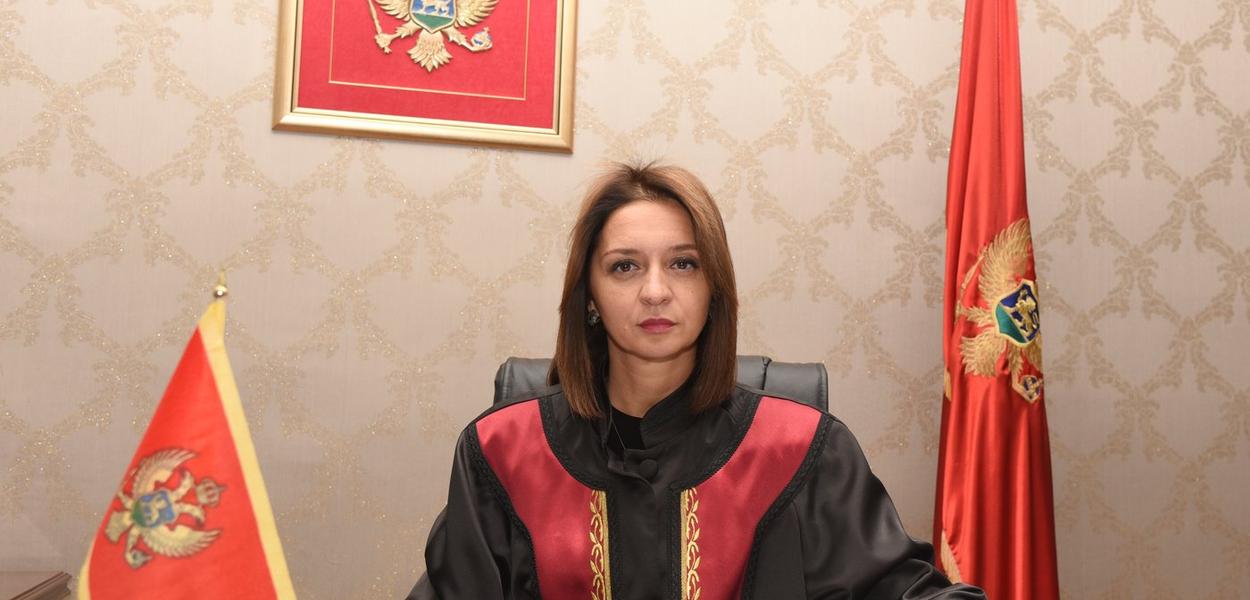
Through its rulings, the Constitutional Court of Montenegro will continue to demonstrate zero tolerance for cases of abuse, particularly with regard to persons suspected of being subjected to torture and other inhuman or degrading treatment while under state control, such as in detention facilities - said the President of the Constitutional Court Snežana Armenko at the presentation of the report „Monitoring of Trials in Cases of Torture and Gender-Based Violence“, organized by Human Rights Action and the Women’s Rights Center.
As stated in the press release, the President of the Constitutional Court recalled that for many years the Court has addressed the effectiveness of the actions of state authorities in cases involving torture through several well-known cases, such as the Zlatarska Street case, the beating of Milorad Mijo Martinović, and the Milić and Nikezić case, all of which also reached the European Court of Human Rights.
As emphasized, the HRA and WRC analysis covered four decisions of the Constitutional Court related to torture. Armenko said she was pleased that Human Rights Action recognized that the practice of the Constitutional Court over the past three years has represented an important corrective to institutional shortcomings in the conduct of the police, state prosecution offices, and courts.
- As you yourselves have noted, an important contribution of the Constitutional Court is reflected in the case concerning inadequate sentencing policy in line with the latest standards of the European Court of Human Rights in a case of torture at the Prison Administration (UIKS). This case marked a turning point in the previous practice of the Constitutional Court in these most sensitive matters, which are crucial both for the protection of the rights of these individuals at the national level and for the reputation of the state internationally. Our contribution was therefore to emphasize and establish the standard that it is not enough to obtain a conviction, sentencing policy must also be such as to deter such conduct, especially by those who are entrusted with protecting persons under their control, far from the eyes of the public - Armenko stressed.
After the Constitutional Court upheld the constitutional complaints of the abused individuals, Armenko said, they initiated civil proceedings seeking compensation for non-pecuniary damage.
- Now it is up to the courts, guided by our practice, to properly assess and apply the standards from the decisions of the Constitutional Court so that violations are not repeated and so that adequate compensation is awarded at the national level. I would like to remind you that respect for the decisions of the Constitutional Court is continuously emphasized by the European Court of Human Rights as well, including in its most recent judgment Lipa v. Montenegro, and by the European Commission - Armenko said.
She added that the Constitutional Court is the last line of defense for the protection of human rights at the national level and is therefore an active and final participant in judicial proceedings from the perspective of the protection of human rights and freedoms.
- When the European Court of Human Rights finds a violation, it first assesses whether the Constitutional Court recognized that violation. Thus, the authority for the protection of human rights at the national level, as well as the greatest responsibility, lies with the Constitutional Court. On the other hand, primary protection of subjective and fundamental human rights and freedoms is provided by ordinary and specialized courts, because by adjudicating cases, they are in fact adjudicating human rights - Armenko emphasized.
Armenko noted that the observation in the analysis, that applicants in the analyzed torture cases before the Constitutional Court waited up to three years for justice, is entirely justified. Precisely for this reason, she said, it is important that through proper work organization and the dedication of professional staff, the Court has reached a point where there are currently no constitutional complaints pending for more than two years.
- However, regardless of the number of constitutional complaints before the Constitutional Court and the overall caseload, constitutional complaints concerning alleged violations of the prohibition of torture will always be a priority for the Constitutional Court - she added.
Armenko warned that an increasing number of complex and challenging cases are coming before the Constitutional Court, requiring serious analysis and well-trained staff who will fully apply European standards so that citizens can obtain justice before domestic authorities, without having to wait for proceedings before the European Court of Human Rights, where decisions can also take several years.
- Fast, efficient, but above all high-quality resolution of these cases is not possible without state investment. Above all, this requires the adoption of a new Law on the Constitutional Court, because in applying the existing law - which has been in force in the legal system for eleven years - we have identified numerous issues that are ripe for change in order to permanently resolve questions of the Court’s status, independence, and autonomy, following the model of the constitutional courts of developed European Union countries whose standards we seek to meet - Armenko concluded.