



Although nearly 80% of citizens say they can recognise propaganda, 40% have shared false information

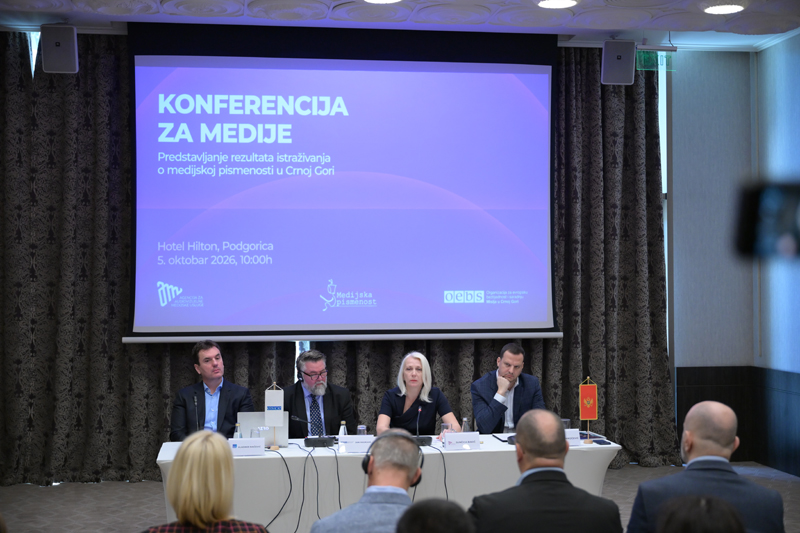
Nearly 80% of Montenegro’s citizens believe they can recognise propaganda and bias in the news, while 40% have already shared content that later turned out to be false or misleading, according to a public opinion survey on media literacy.
Vladimir Raičević of IPSOS said that 79% of the population feel confident in recognising propaganda and bias in the news.
- Forty per cent of the population have already shared a news story that later turned out to be false or misleading - Raičević said.
The survey, commissioned by the Agency for Audiovisual Media Services and conducted by IPSOS from 26 May to 17 June, covered a sample of 1,013 respondents.
Raičević said that 79% of citizens feel confident in recognising propaganda and bias in the news.
He said that more than 90% of citizens use television and smartphones, while computer use is declining.
According to him, more than 93% of citizens have access to and use the internet, while more than 40% of the population spend four or more hours online every day.
Raičević said that Facebook and Instagram are the most widely used social media platforms, each used by 66% of citizens, followed by YouTube at 39% and TikTok at 34%.
As he noted, TikTok is the fastest-growing social media platform, with its number of users having nearly doubled compared with 2023.
Raičević said that 20% of citizens do not have an account on any social media platform, compared with 24% in 2023.
Television is the main source of information for citizens, at 61%, followed by social media at 54%, online media at 49% and personal contacts at 38%.
Raičević said younger citizens are more likely to turn to social media for information, while older people prefer television.
He said that 48% of respondents trust the media, while 46% do not, adding that complete distrust in the media has increased by four percentage points.
According to him, citizens place the greatest trust in information obtained through personal contacts, at 75%, and the least trust in information from social media, at 34%.
Raičević said that 61% of respondents believe the media have a significant influence on the way they think, while 81% believe there is strong political polarisation in the media.
As he noted, the figure for political polarisation has remained unchanged compared with 2023.
The survey also showed that almost every citizen encounters misleading or biased content.
Raičević said that 64% of respondents consider social media a breeding ground for fake news, while 47% say the same of online media and 31% of television.
He said that 63% of respondents occasionally or frequently believe information that later turns out to be false.
According to him, 51% of respondents correctly define fake news as content deliberately designed to mislead people, while 65% believe fake news is widespread and poses a serious threat to democracy.
Raičević said that 88% of respondents consider media literacy important for the general public, while 59% rate the level of media literacy as poor.
The Media Literacy Index, measured on a scale from zero to 25, stands at 12.16, almost identical to the 2023 result of 12.21.
Raičević said education has the greatest influence on the level of media literacy.
The Director of the Agency for Audiovisual Media Services Sunčica Bakić said education remains one of the key factors in media literacy.
- At the same time, the survey’s recommendations point to the need to develop critical information verification skills, provide education tailored to different generations, improve understanding of algorithms and artificial intelligence, and strengthen the integration of media literacy into formal education - Bakić said.
She said individual activities, no matter how high-quality, are not sufficient unless they are connected within a long-term system.
- We need a clear national plan and a concept for developing media literacy - a plan that will not last only as long as a single campaign or project - Bakić said.
According to her, such a plan should bring together the education sector, the regulator, media organisations, universities, civil society, technology platforms and international partners.
Bakić said the Media Literacy Index has little meaning if it is merely a number.
- Its real value lies in showing us whether we are making progress - she said.
She noted that technology would develop faster than laws, curricula or institutions could change.
- We cannot predict every new platform or anticipate every new form of manipulation, but we can build a society in which critical thinking is not merely a reaction to the next piece of disinformation, but an everyday habit - Bakić said.
Head of the OSCE Mission to Montenegro Jan Haukas said media literacy is not solely a matter of education.
- It is an important part of building resilient societies and helping citizens navigate an information environment that is becoming increasingly complex - Haukas said.
According to him, media literacy education must be tailored to different age groups rather than applying a one-size-fits-all approach.
Haukas said media literacy should be integrated throughout formal education and linked to existing curricula.
He added that journalists and newsrooms have a key role in providing verified information, presenting different perspectives and helping citizens understand complex issues.